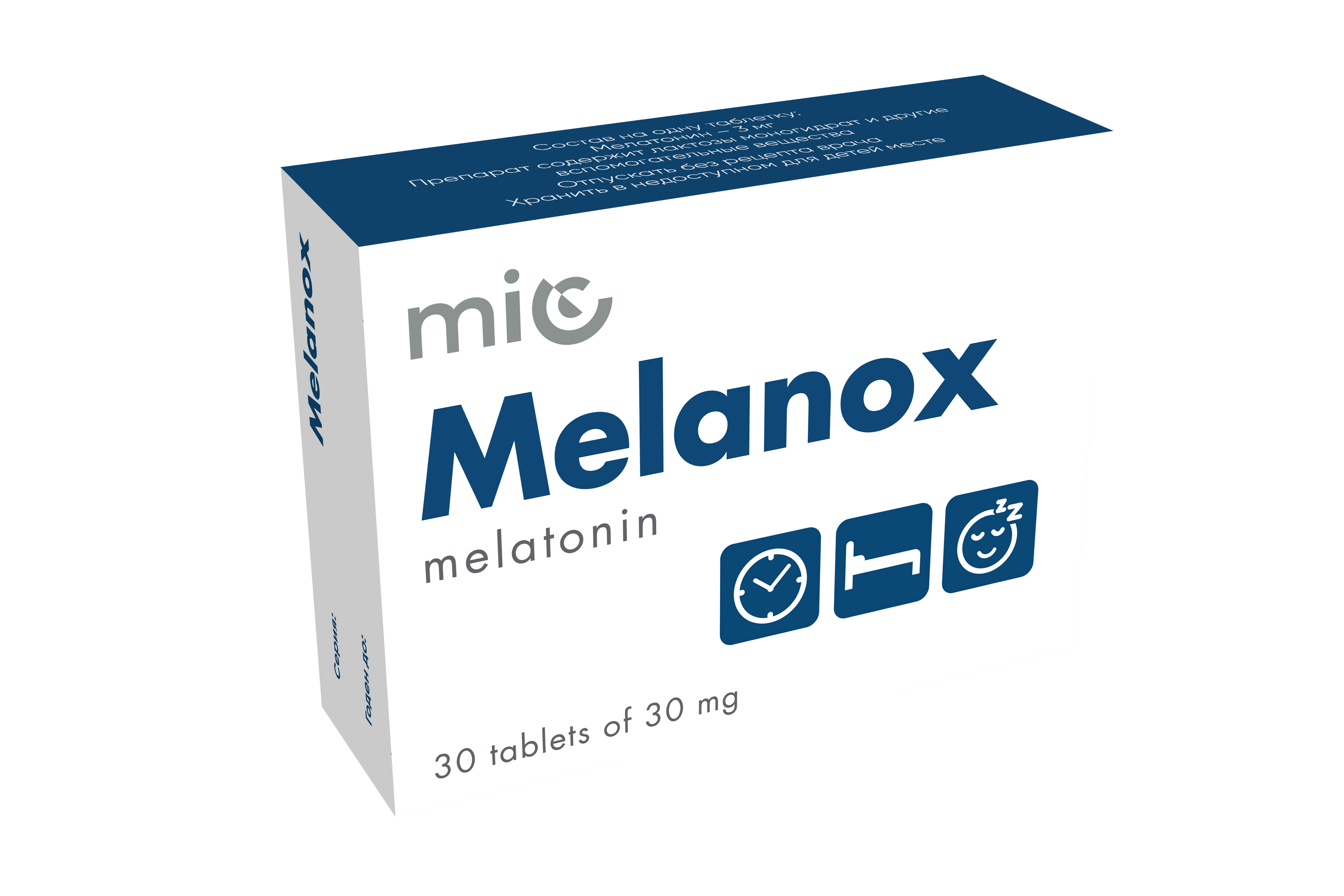
- Drugs
- Psychoneurology
For sleep disorders, including those caused by disruptions to the sleep-wake rhythm.
-
Composition per capsule
melatonin 3 mg
-
Pharmacological action
Pharmacodynamic properties
Pharmacodynamic group: Psychotropic drugs. Hypnotic and sedative drugs. Melanin receptor agonists.
Mechanism of action:
Melatonin is a synthetic analogue of the pineal gland (epiphysis) hormone; performs hypnotic, sedative, adaptogenic action. Normalizes circadian rhythms. Increases the concentration of gamma-amino acid (GAC) and serotonin in the middle brain and hypothalamus, and alters the activity of pyridocsalkinase involved in the synthesis of GAC, dopamine, and serotonin. Regulates the “sleep – wakefulness” cycle, daily changes in locomotor activity and body temperature, positively affects intellectual and mental brain functions, emotional and personal sphere.
Facilitates the organization of biological rhythm and normalization of sleep at night. Improves the quality of sleep, speeds up falling asleep, decreases the number of late-night awakes, improves the well-being after morning awakening, does not cause the feeling of slackness, weakness, exhaustion upon awakening, regulates neuroendocrine functions. Adapts the bodies of meteo-sensitive people to the change of weather. Does not cause addiction and dependence.
Pharmacokinetic properties
Absorption
After ingestion melatonin is quickly absorbed into the gastrointestinal tract. In elderly patients the speed of absorption can be reduced by 50%. When taken inwardly at a dose of 3 mg the maximum concentration (Сmax) in blood plasma and saliva is reached in 20 and 60 minutes accordingly. Time to reach Cmax in the serum is 60 minutes (normal range is 20-90 minutes). After ingestion 3-6 mg of melatonin Cmax in the serum is usually 10 times more than endogenous melatonin in the serum at night. Simultaneous eating delays absorption of melatonin.
Bioavailability
The bioavailability of melatonin when ingested ranges from 9 to 33% (approximately 15%).
Distribution
In researches in vitro the binding of melatonin to blood plasma proteins is 60%. Melatonin is mainly bound to albumin, α1- acid glycoprotein and high-density lipoproteins. Distribution volume - about 35 l. Rapidly distributed in saliva and passes through the haematoencephalic barrier, determined in the placenta. Concentration in cerebrospinal fluid is 2.5 times lower than in blood plasma.
Biotransformation
Melatonin is metabolized primarily in the liver. After taking inwardly, it undergoes a significant metabolism during "primary passage" through the liver, where it is hydroxylated and conjugated with sulphate and glucuronide to form 6-sulfatoxymelatonin. The level of sedimentary metabolism can reach 85%. Experimental researches suggest that isoenzymes are predominantly involved in melatonin metabolism. CYP1A1, CYP1A2 and possibly CYP2S19 of the R450 cytochrome system. The main metabolite of melatonin is 6-sulfathoxymelanone, is inactive.
Elimination
Melatonin is excreted from the body by the kidneys. The average half-time excretion (T1/2) is 45 minutes. Extraction is carried out by the kidneys, about 90% in the form of sulphate and glucuronic 6-hydroxymelanone conjugates, and about 2-10% is removed unchanged. Pharmacokinetics are influenced by age, caffeine intake, tobacco use, and oral contraceptives. These patients experience accelerated absorption and impaired elimination.
Linearity (non-linearity)
Pharmakokinetics of melatonone in the dose range 2-8 mg - linear.
Pharmakokinetics in special groups of patients.
Patients with impaired renal function
During long-term treatment, cumulation of melatonin is not observed. These data are consistent with short T1/2 melatonin in humans.
Patients with liver impairment
Liver is the main organ involved in melatonin metabolism, so liver disease leads to increased concentration of endogenous melatonin. In patients with cirrhosis of the liver, plasma concentration of melatonin increased significantly during daytime hours.
Elderly patients
It is known that melatonin metabolism slows down with age. At different doses of melatonin, higher areas values for AUC and Cmax are obtained in elderly patients, reflecting reduced melatonin metabolism in this group of patients.
Melanox is recommended for people over 18 with sleep disorders, including the cases caused by disturbances in rhymes of “sleep and wakefulness”, such as desynchronosis (sudden change of time zones).
The dosage and method of usage:
The dosage:
In case of sleep disturbances:
1 pill 30-40 minutes before sleep, 1 time a day
In case of desynchronosis as an adaptor during changes of time zones:
1 day before the flight and for the next 2-5 days 1 pill 30-40 minutes before sleep.
The maximum dosage is – 2 pills a day.
Special patient groups
Elderly patients
With age, melatonin metabolism decreases, which should be taken into account when choosing a dosage regimen for elderly patients. According to that, elderly patients may receive melatonin 60-90 minutes before sleep.
Patients with impaired renal function
The effect of varying degrees of renal impairment on melatonin pharmacokinetics has not been studied, so Melanox should be taken with caution in patients with mild and moderate degree of renal impairment. The use of the drug in patients with severe renal insufficiency (creatinine clearance <30 ml/min) is contraindicated.
Children
The safety and efficacy of melatonin in children under 18 is not known. Melanox is contraindicated for use in children under 18.
The method of usage
Inwardly. Swallow the pill whole, drinking plenty of water. -
Indications for usage
Fertility, pregnancy and lactation
Pregnancy
Data on the use of melatonin in pregnant women are insufficient or limited.
Use of Melanox is contraindicated during pregnancy and in women planning pregnancy.
Lactation
Endogenous melatonin is defined in breast milk, so it is likely that exogenous melatonin can also permeate into breast milk.
If the use of Melanox during lactation is necessary, breastfeeding should be stopped.
Contraindications
-Hypersensitivity to the active substance or to any of the auxiliary substances.
-Severe renal impairment (СС less than 30 ml/min).
-Autoimmune diseases (no clinical data available).
-Liver insufficiency.
-Pregnancy and breastfeeding period.
-Up to 18 years (no efficacy or safety determined).