- Drugs
- Therapy
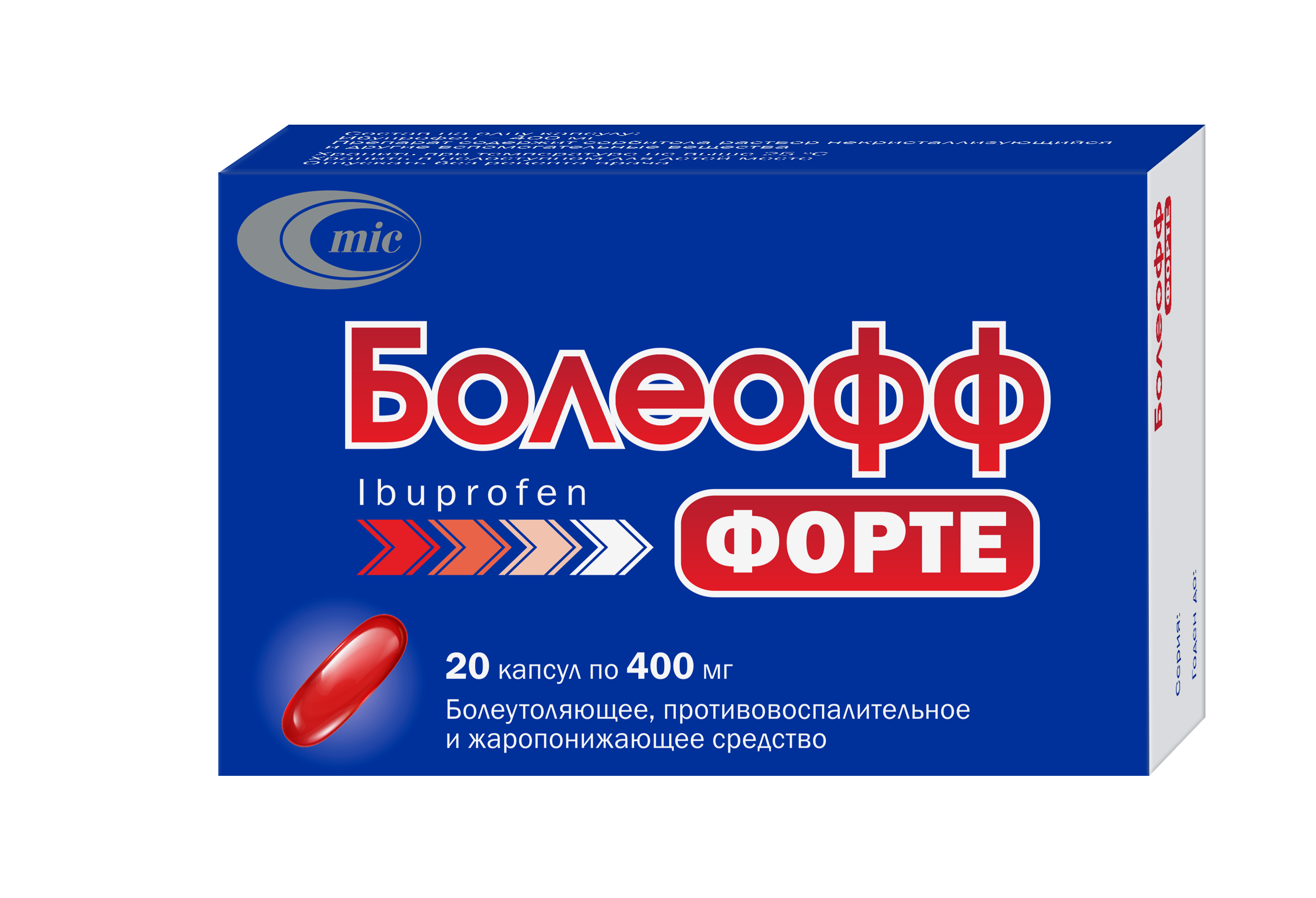
An analgesic, antipyretic, anti-inflammatory drug in capsules with a liquid center.
-
Composition per capsule
400 mg ibuprofen
-
Indications for usage
Indications for usage
Boleoff forte is indicated for use in adults and children from 12 years and over with a body weight of 40 kg or more for the short–term symptomatic treatment of:
- mild to moderate pain, including headache, migraine, toothache, dysmenorrhea, neuralgia, mild rheumatic, muscle pain, back pain and back joints pain;
– fever, flu and colds.
Dosage regimen and administration
For a short-term use only.
In order to minimize the risk of adverse reactions, Boleoff forte should be taken in the lowest effective dose and for the shortest possible period necessary to achieve a clinical effect.
With a short-term use, if symptoms persist or worsen, the patient should consult a doctor.
Dosage regimen
Adults and children over 12 (with a body weight of 40 kg or more)
The recommended dose is 1 capsule up to three times a day as needed.
The intervals between drug intake is at least 4 hours.
Do not take more than 3 capsules (1,200 mg) within 24 hours.
If children and adolescents need to take this medication for more than 3 days, or if symptoms worsen, consult a doctor.
If adults need to take the drug for more than 3 days in case of fever and more than 4 days to relieve pain, or if symptoms worsen, the patient shall consult a doctor.
Patients with diseases of the gastrointestinal tract (GIT) are recommended to take this drug during meals.
When taken after a meal, the effect of the drug may slow down. In this case, you should not take a large dose of the drug. The required interval between the two doses must be observed.
Special patient groups
Patients with impaired renal function
In patients with mild or moderate renal impairment, dose reduction is not required. Boleoff forte is contraindicated in patients with severe renal insufficiency.
Patients with impaired liver function
In patients with mild or moderate hepatic impairment, dose reduction is not required. Boleoff forte is contraindicated in patients with severe hepatic insufficiency.
Elderly patients
Dose adjustment is not required for elderly patients. Due to the possible development of adverse reactions, careful monitoring of the condition of elderly patients is recommended when taking the drug.
Children
The drug Boleoff forte is not recommended for use in children under 12 and with a body weight of less than 40 kg.
Method of application
Take it orally with plenty of water.
For a short-term use only.
Contraindications
– Hypersensitivity to ibuprofen or to any of the excipients.
– History of hypersensitivity reactions (like bronchospasm, bronchial asthma, rhinitis, angioedema or urticaria) after taking acetylsalicylic acid or other nonsteroidal anti-inflammatory drugs (NSAIDs).
– Bleeding or perforation of the gastrointestinal wall caused by previous NSAID therapy.
– Erosive and ulcerative diseases of the gastrointestinal tract (including peptic ulcer of the stomach and duodenum, Crohn's disease, ulcerative colitis) or ulcerative bleeding in the active phase or in the anamnesis (two or more confirmed episodes of peptic ulcer disease or ulcerative bleeding).
– Renal, hepatic, or heart failure (NYHA Class IV – classification of the New York Association of Cardiology).
– Cerebrovascular or other active bleeding.
– Hemophilia and other blood clotting disorders (including hypocoagulation).
– Hemorrhagic diathesis.
– Unexplained hematopoiesis disorders.
– The period after coronary artery bypass grafting.
– Severe dehydration (as a result of vomiting, diarrhea, or insufficient fluid intake).
– The third trimester of pregnancy.
– Body weight less than 40 kg and children under 12 years old.
– Fructose intolerance.
Pharmacodynamic properties
Pharmacotherapeutic group: Anti-inflammatory and antirheumatic drugs. Nonsteroidal anti-inflammatory and antirheumatic drugs.
Derivatives of Propionic acid.
ATC Code: M01AE01
Mechanism of action
The active ingredient of the drug Boleoff forte is ibuprofen. Preclinical studies of traditional models of infectious diseases demonstrate the effectiveness of ibuprofen as an inhibitor of prostaglandin synthesis against mediators of pain, inflammation and hyperthermia. In humans, ibuprofen has a pronounced analgesic, antipyretic and anti-inflammatory effect. In addition, ibuprofen reversibly inhibits ADP and collagen-induced platelet aggregation.
Pharmacodynamic effects
Ibuprofen is a potent inhibitor of cyclooxygenase-1 and cyclooxygenase-2 enzymes, which inhibits prostaglandin synthesis. Ibuprofen suppresses the migration of white blood cells to the area of inflammation. Ibuprofen has also been shown to have a pronounced effect on the spinal cord, which appears to be partly due to cyclooxygenase inhibition. The antipyretic properties of ibuprofen are associated with central prostaglandin inhibition at the hypothalamic level.
Experimental data suggest that ibuprofen can competitively inhibit the effect of a low dose of acetylsalicylic acid on platelet aggregation when taken concomitantly. Some pharmacodynamic studies show that with a single 400 mg ibuprofen dose 8 hours before or 30 minutes after intake of immediate-release acetylsalicylic acid (81 mg), there was a decrease in the effect of acetylsalicylic acid on thromboxane formation or platelet aggregation.
Although there are uncertainties regarding the extrapolation of these data to the clinical situation, it cannot be ruled out that regular long-term ibuprofen intake may reduce the cardioprotective effect of low doses of acetylsalicylic acid. Clinically significant effect with episodic administration of ibuprofen is considered unlikely.